
Updated from its original posting on Nov 12, 2024, this article is listed as Argument 4 in the Index of Articles of this series.
Forming the structure of our house of knowledge, the principle gives us spiritual understanding of how blindness allows each moral standard to make itself out to be superior over the others We need knowledge of how this works through the word-symbol evil and the duality name.
Our goal is for everyone’s morals/ethics to improve through unconditional love, agapé. This frees democracy from the mindset of moral superiority so that it can mature — rejecting the outward appearance of moral maturity created by the hypocrisy in misuse of moral standards to judge others.
The Word-Symbol Evil
By declaring our own moral superiority, we see others to be the manifestation of evil as a substance and not a state of mind as it is.1 Knowledge of Word explains it this way:
“To the clean [in mind and conscience, possible only by not violating our nature of love or when violating it seeking forgiveness], all things (are) indeed clean [including perception of all physical bodies, while the immoral/unethical actions of people indicate defilement in their mind and conscience],
But to those having been defiled [in their mind and conscience, due to violating our nature to love and not seeking forgiveness] and unbelieving [not believing in our true nature], nothing [appears] clean, but both their mind and conscience is* defiled.”
(*Argument 5 explains that this is not a grammatical error and why.) The defiled mind and conscience are not a substance but a state, reversable in ourselves through forgiveness. Thus, the word evil is a word-symbol with no substance. Without understanding this, we blind ourselves to the appearances we form behind this word-symbol by giving these appearances an evil substance in our mind. And worse, we blind ourselves to what we are all actually doing in substance—giving Name all our agapé light through each other in the singularity of Word. It is a perpetual act of this light, likened to the circulation of blood to and from our heart.
In The Spiritual Story of Democracy, the word-symbol evil and blindness are given the substance of Word’s piety light so that we can acknowledge their presence in the world suneidesis without taking away from Name’s agapé light.
The Duality Name
Blindly forming evil while unknowingly giving Name our agapé light is summed up in Word saying, “I know your deeds, [ones that indicate] you have a name [declaring] that you are alive and you are dead.” With knowledge of this duality name, we can understand how the beautiful story of Name’s agapé light is turned into a life of addiction in the spirit and flesh (see Contribution 2: Prejudice and Addition in the Diamond Light Blinded).
Time in the Spiritual Death of Addiction
Governing our national conscience (suneidesis),2 Democratic and Republican moral standards are waging spiritual civil war in Word’s jasper light. It divides us with illusory political boundaries that work in the duality name, where addiction rules and agapé is seen as evil in the part of the name that is dead. Under such addiction, we still love others even strangers when in need, but democracy is a blessing that is earned only by loving the enemies of suneidesis.3 For Word taught that there is no reward for loving those who love us, but there is great reward for loving those who hate us. Democracy is that great reward on earth.
One vitally important change working in the duality name is awareness of time in the singularity of Word. Our suneidesis is collective awareness of time, thus, under addiction, we collectively misperceive time. The aspect of conscience in our suneidesis directly causes time to be experienced two ways—when guilty as slowed down, every second a pound of regret, and sped up when clear, as time flies when we are feeling good in our conscience, blindly or not.
However, the “spiritual time” of our suneidesis is the immeasurable and eternal agapé light of Name. It cannot be experienced physically, but Word gives us a symbolic reference, one which we can call the Now of Word, a 2,000-year existence of the present in our suneidesis. This is the timeframe of the beautiful story of Name’s agapé light, experienced in spiritual blindness through addiction to conditional agapé and hate, both formed by Word’s jasper light.
Conduits of Name’s Agapé
As names of light, we exist in Word’s singularity of life by being conduits of Name’s agapé light. We give Name all our agapé through each other, that is, we return Name’s agapé for us in the purest way, starting through those whose vision of Word’s singularity is one of blind hatred. We, too, are simply superseded in our awareness when blinded to this perpetually taking place, again, as the circulation of blood never stops flowing through the heart. But when the duality name symbolically takes over both chambers of our heart, we cannot participate knowingly.
Without the wholeness that comes from knowingly participating in Name’s agapé light, we try to substitute it with addictive thinking patterns that reflect in our physical bodies and words. It ranges from addiction to praising Name as a substitute for loving the enemies of suneidesis to hating them and believing that that pleases Name. By reflecting in our physical bodies, it produces physical addictions but also a pattern to identify and break spiritual addiction when we are ready to follow the principle.
Spiritual Fasting and Our Own Flesh
As discussed, the physical addiction of others that appeared in Paul’s flesh did not tempt him because he was free from all addiction. He did not allow misuse of surface appearances to stop him from seeing Name’s agapé light in everyone. For seeing the duality name in anyone moved Word in Paul to reflect the activity of Name’s agapé light in them into the part of their duality name designating them spiritually dead and formed out of Word’s jasper light.
Recognizing the duality name in others empowered Paul to bear their addiction in his flesh, which we can call spiritual fasting according to the knowledge of Word. We do not deny our bodies food and water in this kind of fast. We, when free from all addiction, bear the addiction of others in our flesh according to “spiritual time”, thus having the need not to veil ourselves from our flesh when doing so, as implied in this passage.
“Is this not the fast that I [Name] have chosen, to loosen the bonds of wickedness, undo the bands of the yolk, and let the oppressed go free and break every yolk…to divide your bread with the hungry, bring the homeless poor into your house, when you see the naked cover them—and not to veil yourself from your own flesh…furnish your soul to the hungry and you will satisfy the soul of the oppressed; then your light will rise in the darkness, and your sunset [will be] like noonday.” Isaiah 58:6-7; 10
Word expanded this to include enemies of suneidesis, oppressors, when explaining that the judgment of our national suneidesis is based on how we treat “the least among us”. We should treat them the same way Isaiah spoke of when spiritually fasting. We must not veil ourselves from our own flesh so that we can bear their addiction in it through Word as—if they are ready to accept the principle—it loosens the bonds of wickedness in them.
In essence, Word breaks the hold blindness has on them for judging others through misuse of the word-symbol evil and then oppressing them. Thus, our part is to identify the effects of believing—that the word-symbol evil has substance—has on their blindness and body, and remove it in our suneidesis and body once bearing it there. Not veiling ourselves from our own flesh to do this is supported by knowing that Word permeates our joints and marrow.
Likewise, by accepting the principle or learning how to use it better through The Practical Guide, we can do our part to identify misuse of the word-symbol evil in ourselves, with its symbolic jasper light, and break spiritual addiction in ourselves or simply see Word in others better. It sets us free in Word’s singularity to see Name’s agapé light in the dead part of our own duality name or memories of it, in essence, doing away with the duality name in ourselves or rendering memory of it in ourselves completely useless.
A Symbolic Diagram With and Without the Duality Name
The upper half symbolizes the part of the duality name that designates us spiritually alive and the lower half the part that designates us spiritually dead. We will discuss it further in the next article, Argument 5. For now, consider the rose in the middle, symbolizing the beauty and pleasures of life. They work in both parts of us, spiritually alive and spiritually dead. When the duality name no longer exists in us, the lower half of the diagram symbolizes our spiritual fast for others.
As discussed in previous articles, envisioning Name and giving it all our agapé through each other is central to building our house of knowledge. This diagram can not only help us learn how to envision but it can even help our agapé grow. For as knowledge of Word puts it, agapé grows and grows in knowledge and all perception. Our minds need knowledge to build a house that can envision Name giving all its agapé to us through the singularity of our democracy. That is powerful perception that will make our agapé grow and grow.
One of the ways this diagram helps us do this is by using symbols that represent us as names of light in the singularity of Word, with our human form symbolized as something we possess, not who we are. (Note that the object-symbols in the diagram are better understood when viewed up close for better focus. This can be done on the phone app but not on the web version.)
The Symbolic Diagram
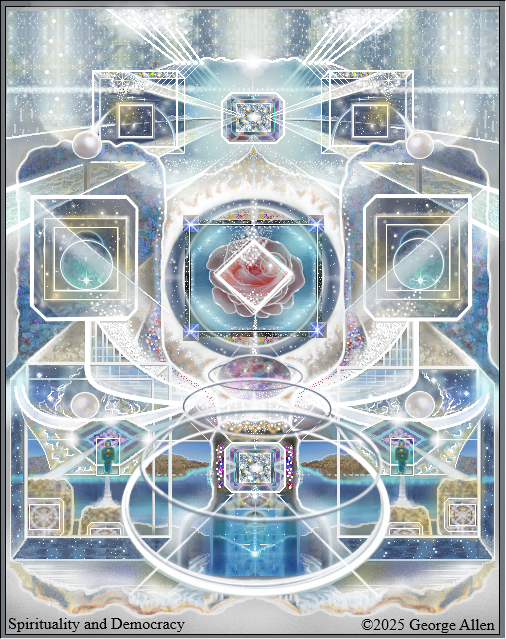
This diagram is not AI generated precisely because it would have glass realism reflecting light that dazzles and overwhelms our sensitive optical system — and that would work against its intended use of having us form its images permeationally in our mind. Its correct usage is explained in Argument 5.
Suggested articles:
The Eyes of Democracy (Introduction and Index of Articles)
Consider the reasoning behind what words are.
Words are labels for the things we can experience with our senses but are symbols for the things we cannot experience this way.
When word-symbols are true, they transform into living words in our mind.
For example, the word-symbol “love” is true when it is unconditional, for love waiting for conditions stops being love. Thus, the word-symbol love or agapé transforms into living agapé in us, an experience not a label for an experience.
We can know this because we are living and know when some aspect of us is living or not. This is how we know that agapé is real.
When word-symbols are not true, they not only do not transform in us but build an imaginary world of words in our minds, where agapé is not real. So since democracy is about people who care for each other enough to keep their democracy, the essential level of unconditional love, agapé, democracy without agapé is an imaginary world in our minds.
Remember, the word democracy is a symbol because we cannot experience it with our senses. It is not buildings or even people themselves. Democracy is a symbol in our minds and hearts that joins us together. Anyone working against that unity is living in an imaginary world of democracy.
Suneidesis, pronounced soo-NAY-day-sis, is a Greek word that joins our natural awareness with our sense of conscience. Click on the link for a detailed explanation. It is central to this teaching. Using this foreign word regularly in discussions helps us get accustomed to experiencing something new and positive working in our awareness itself. When the word conscience is used, it will refer to the aspect of suneidesis that involves right and wrong, but this aspect cannot be separated from our co-conscientious awareness of all things.
If I understand that my awareness of something as simple as a cup includes co-conscientiousness, I do not allow myself to get blinded by the cup alone but know it as part of all creation at the hands of the Creator or the universe, depending on one’s beliefs. Spiritual maturity does this naturally.
The repetition of suneidesis is meant to challenge you to consider this dimension in your awareness. Apologies, but it will only be a necessary annoyance until it becomes natural.
I want to thank you for following me and I will follow you back. I don’t know if I understand everything you’re writing about here. You use special terms. This post is written in generalities, but I’m still quite fascinated to read what you are writing.
Thanks again for following me. 🤗